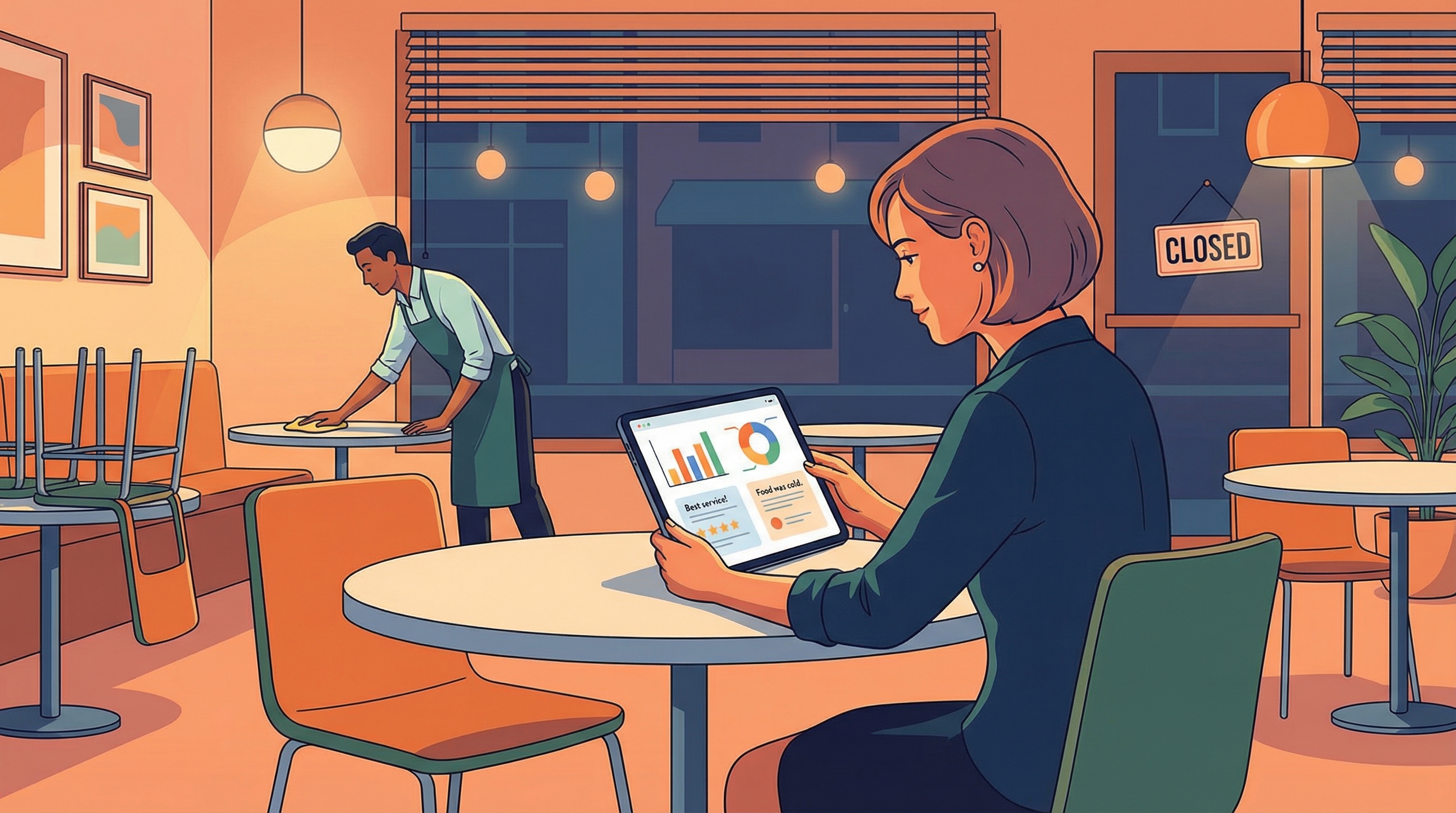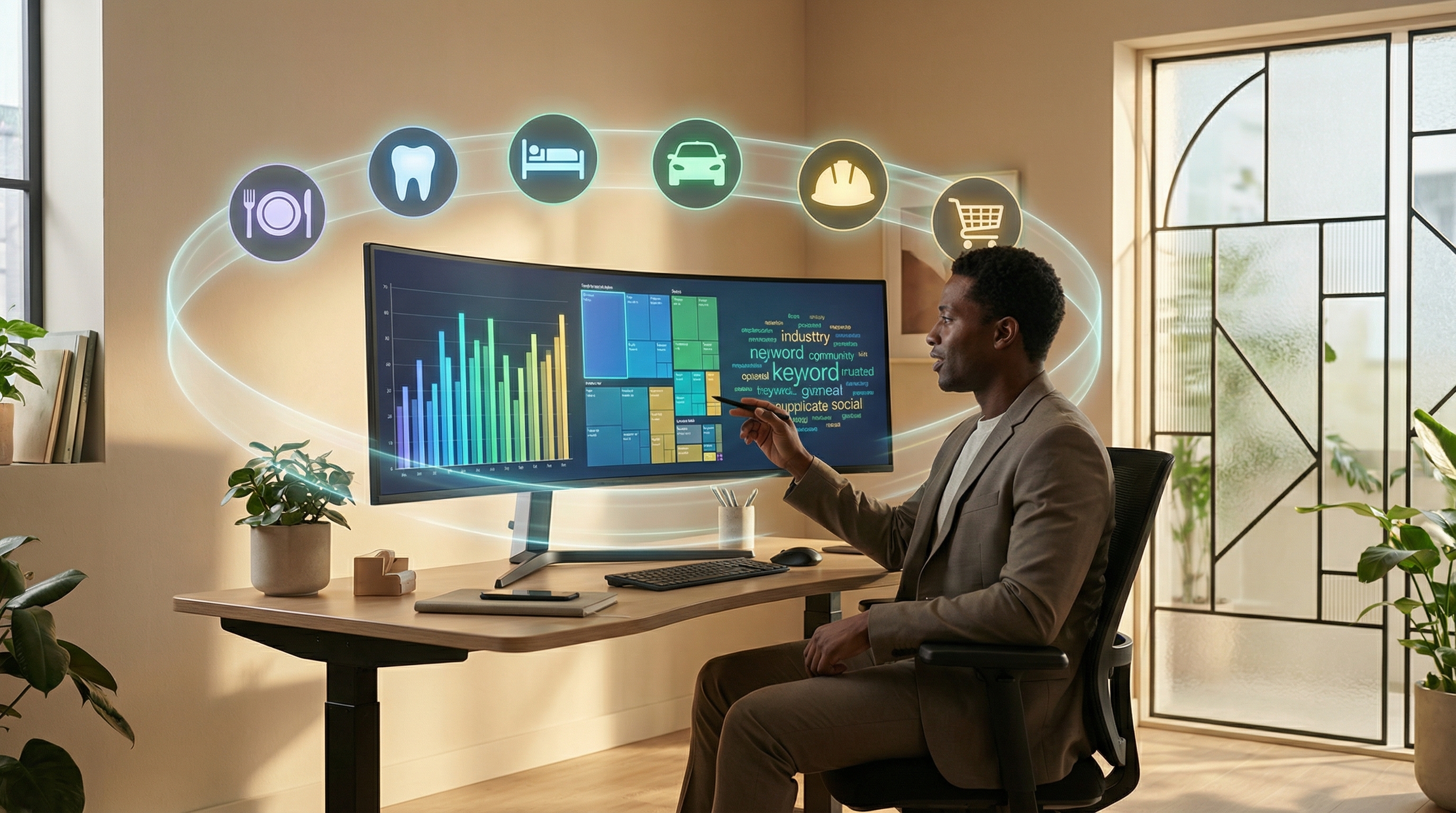
Every restaurant, dental practice, hotel, auto shop, and retail store generates a steady stream of Google reviews — but most business owners treat them as a scorecard rather than a strategic asset. What if you could decode the patterns hidden inside hundreds of customer reviews and turn that data into a concrete growth plan?
That's exactly what review analysis by industry makes possible. Whether you're running a restaurant customer feedback analysis to understand why diners stop coming back, performing a dental practice review analysis to uncover patient anxiety triggers, or conducting a hotel review analysis on Google to benchmark against competitors, the approach varies dramatically by sector. The keywords customers use, the emotions they express, and the priorities they rank highest all shift depending on the type of business they're reviewing.
This guide breaks down what review analysis looks like across six major industries — restaurants, dental practices, hotels and hospitality, auto repair shops, home services and contractors, and retail stores — so you can extract the insights that actually matter for your business.
Why Industry Context Changes Everything in Review Analysis
A five-star review for a plumber and a five-star review for a fine-dining restaurant share almost nothing in common beyond the star count. The language, expectations, and emotional triggers are entirely different.
Research from Harvard Business School has shown that a one-star increase on Yelp can lead to a 5–9% increase in revenue for restaurants. But the same study wouldn't apply uniformly to an auto repair shop, where trust and transparency outweigh ambiance. This is why generic sentiment analysis falls short — and why industry-specific review analysis delivers dramatically better insights.
Here's what changes by industry:
- Customer priorities: Speed matters most in fast food; bedside manner matters most in dentistry
- Language patterns: Hotel guests talk about "amenities" and "cleanliness"; auto shop customers talk about "honesty" and "estimates"
- Emotional intensity: Healthcare reviews skew more emotional; retail reviews tend to be more transactional
- Benchmark expectations: A 4.2-star rating might be excellent for a contractor but below average for a hotel
Understanding these differences is the foundation of effective review analysis.
Restaurant Google Review Analysis: Beyond Stars and Food Photos
Restaurants are among the most reviewed businesses on Google, with the average independent restaurant accumulating hundreds of reviews within a few years. A thorough restaurant review analysis goes far beyond tracking your average rating.
What Restaurant Review Data Reveals
When you analyze restaurant reviews systematically, recurring themes emerge that are invisible when reading reviews one at a time:
- Service consistency: Are complaints about slow service concentrated on weekends? That's a staffing problem, not a training problem.
- Menu item sentiment: Which dishes generate the most praise — and which ones silently drive negative reviews?
- Ambiance and experience: Customers increasingly review the full dining experience, not just the food. Noise levels, lighting, and seating comfort all surface in thematic analysis.
- Value perception: Price complaints often correlate with portion size mentions rather than absolute dollar amounts.
According to a 2024 TouchBistro report, 90% of diners research a restaurant online before visiting, and Google reviews are the most consulted source. A restaurant customer feedback analysis helps you understand not just what customers think, but why — and what to fix first.
Key Metrics for Restaurant Review Analysis
- Sentiment by category: Food quality, service speed, ambiance, value, cleanliness
- Peak complaint periods: Monthly or seasonal trends in negative reviews
- Staff mentions: Which employees generate praise (or complaints) by name
- Competitor mentions: What customers say about you versus nearby restaurants
Dental Practice Review Analysis: Understanding Patient Anxiety
Dentistry is one of the most anxiety-driven service industries, and that anxiety shapes every review patients write. A dentist Google review analysis reveals patterns that patient satisfaction surveys often miss.
What Dental Office Reviews Analysis Uncovers
- Fear and comfort language: Patients frequently mention whether they felt "at ease," "comfortable," or "scared." Tracking the frequency of anxiety-related language gives you a direct measure of your chairside manner's effectiveness.
- Wait time sensitivity: Dental patients are disproportionately sensitive to wait times compared to other industries. A 2023 PatientPop survey found that 84% of patients consider wait time important to their overall experience.
- Front desk experience: Dental office reviews analysis consistently shows that the front desk interaction — scheduling ease, insurance handling, friendliness — shapes the overall review as much as the clinical care itself.
- Pain management: Explicit mentions of pain (or the absence of it) are among the strongest predictors of star rating in dental reviews.
Priority Matrix for Dental Practices
| Issue | Frequency | Impact on Rating |
|---|---|---|
| Wait times | High | Moderate |
| Staff friendliness | High | High |
| Pain management | Moderate | Very High |
| Insurance/billing clarity | Moderate | Moderate |
| Office cleanliness | Low | High (when negative) |
A dental practice review analysis helps practice owners see which improvements will move the needle fastest — often, it's not the clinical work but the patient experience surrounding it.
Hotel Review Analysis on Google: The Hospitality Benchmark
Hotels live and die by reviews. A hotel review analysis on Google provides a window into guest expectations that internal quality audits frequently miss.
What Hotel Customer Feedback Analysis Reveals
- Room condition vs. service quality: Hospitality review analysis consistently shows that guests forgive minor room issues when service recovery is excellent — and punish pristine hotels with indifferent staff.
- Breakfast and amenities: These "extras" generate disproportionate review mentions. A 2024 J.D. Power hotel guest satisfaction study found that breakfast quality alone accounts for a significant portion of overall satisfaction variance.
- Check-in experience: The first 10 minutes of a hotel stay shape the entire review. Slow check-in, unsmiling staff, or room-not-ready situations cascade into lower ratings across all categories.
- Location accuracy: Guests frequently review whether the hotel's marketing matched reality — distance to attractions, neighborhood safety, noise levels.
Seasonal Trends in Hospitality Reviews
Hotel customer feedback analysis reveals pronounced seasonal patterns:
- Summer peak: Higher review volume, more family-related complaints (pool access, room size)
- Business travel seasons: More mentions of Wi-Fi reliability, workspace, and early check-in
- Holiday periods: Heightened expectations around décor, special events, and premium pricing justification
Tracking these patterns helps hotel managers allocate resources proactively rather than reactively.
Auto Shop Google Review Analysis: Trust Is the Currency
Few industries depend on trust as heavily as auto repair. An auto shop Google review analysis reveals that customers aren't primarily evaluating technical skill — they're evaluating honesty.
What Auto Repair Review Analysis Shows
- Transparency themes: The most common words in positive auto repair reviews include "honest," "fair," "explained," and "upfront." Negative reviews cluster around "overcharged," "unnecessary," and "didn't explain."
- Estimate accuracy: Customers rarely complain about high prices in isolation. They complain when the final bill exceeds the estimate without clear communication.
- Turnaround time: Auto repair review analysis shows that speed is valued, but only when paired with communication. Customers tolerate delays when they receive updates.
- Repeat customer signals: Phrases like "always come here" or "been coming for years" indicate strong retention — tracking their frequency over time reveals loyalty trends.
Top Drivers of Auto Shop Ratings
- Honest communication about what needs repair and what doesn't
- Estimate-to-final-bill accuracy
- Explanation of work performed in plain language
- Convenience factors: shuttle service, loaner cars, hours of operation
- Cleanliness of waiting area (surprisingly influential)
Contractor and Home Services Review Analysis
From plumbers to electricians to general contractors, home services review analysis reveals a customer base that is uniquely vulnerable — they're letting strangers into their homes and trusting them with expensive, disruptive projects.
What Contractor Google Review Analysis Uncovers
- Communication and reliability: A contractor Google review analysis almost always surfaces communication as the top theme. Showing up on time, returning calls, and providing clear timelines dominate the conversation.
- Cleanliness and respect: Home services review analysis shows that customers care deeply about whether workers treated their home with respect — covering floors, cleaning up debris, and being mindful of pets and children.
- Plumber review analysis specifics: For plumbers specifically, emergency response time and upfront pricing are the two strongest predictors of positive reviews. Customers in crisis situations are especially sensitive to feeling taken advantage of.
- Project completion: Contractor reviews frequently mention projects that dragged on past the estimated timeline. Tracking the frequency of "delayed," "still waiting," and "took longer" gives a direct measure of scheduling reliability.
The Trust Hierarchy in Home Services
- Shows up when promised
- Provides accurate, upfront pricing
- Communicates throughout the project
- Delivers quality workmanship
- Leaves the home clean and undamaged
Notice that quality workmanship ranks fourth — not because it doesn't matter, but because customers evaluate trust and communication before they can even assess the technical work.
Retail Store Review Analysis: The Omnichannel Challenge
Retail store review analysis operates at the intersection of product quality, staff interaction, and physical environment. A retail customer feedback analysis on Google reveals what drives foot traffic — and what sends customers to Amazon instead.
What Retail Customer Feedback Analysis Shows
- Staff knowledge and helpfulness: In an era of self-service, customers who leave Google reviews for retail stores disproportionately mention staff interactions — both positive and negative.
- Product availability: "Out of stock" and "didn't have my size" are among the most damaging phrases in retail reviews. Retail store review analysis can quantify how often inventory gaps appear in customer feedback.
- Return policy experience: The return process generates intense emotional reviews. A smooth return creates loyalty; a difficult one creates a vocal detractor.
- Store environment: Cleanliness, organization, and ease of finding products surface consistently in retail customer feedback analysis.
Retail Review Patterns by Store Type
- Specialty retail: Reviews emphasize expertise and curation
- Big-box stores: Reviews focus on convenience, pricing, and checkout speed
- Boutiques: Reviews highlight uniqueness, personal attention, and atmosphere
- Service-based retail (eyewear, jewelry): Reviews blend product quality with consultation experience
How to Act on Industry-Specific Review Insights
Regardless of your industry, the process for turning review analysis into action follows a consistent framework:
- Identify your top 3 strengths — the themes that appear most frequently in positive reviews. Double down on these in your marketing and operations.
- Isolate your top 3 challenges — the recurring complaints that drag down your rating. Prioritize by frequency and severity.
- Benchmark against your industry — a 4.3-star rating means different things in different categories. Understanding where you stand relative to your peers provides crucial context.
- Track temporal trends — are things getting better or worse? Monthly rating trends reveal whether recent changes are working.
- Extract customer quotes — real language from real customers is more persuasive to your team than any internal memo.
Making Review Analysis Actionable With Zabble Insights
Analyzing hundreds of reviews manually across these dimensions is possible — but it's time-consuming and prone to bias. This is where AI-powered analysis becomes valuable.
Zabble Insights analyzes up to 300 Google reviews (and optionally Yelp reviews) per business, delivering a professional Word document report with sentiment analysis, thematic breakdowns, customer journey mapping, and strategic recommendations — all benchmarked against data from over 6,600 businesses across 22 industry categories. Whether you're running a restaurant, dental practice, hotel, auto shop, contractor business, or retail store, the report adapts its analysis to the themes and patterns that matter most in your specific sector.
Each report includes a customer priority matrix that ranks issues by frequency and severity, with direct customer quotes as evidence — giving you a clear, data-backed roadmap for improvement. Reports start at $99 per business, with no subscription required.
Explore sample reports across industries →
Frequently Asked Questions
How many reviews do I need for a meaningful review analysis?
Most analysis becomes statistically useful at around 80–100 reviews. Below that threshold, individual outlier reviews can skew results. For businesses with 80–300 reviews on Google, AI-powered analysis can identify reliable patterns in sentiment, themes, and trends. If you also have Yelp reviews, combining both sources strengthens the analysis further.
Does review analysis differ between Google Reviews and Yelp Reviews?
Yes, meaningfully. Google reviews tend to be shorter and more rating-driven, while Yelp reviews are typically longer and more detailed in their commentary. Yelp reviewers also skew toward food, hospitality, and personal services. Analyzing both platforms together gives a more complete picture of customer sentiment, especially for restaurants, hotels, and dental practices.
Can review analysis tell me how I compare to competitors?
Direct competitor analysis requires separate review data for each competitor. However, a thorough review analysis can benchmark your ratings and sentiment against industry averages. It can also surface competitor mentions within your own reviews — customers often reference other businesses by name when explaining why they switched to you or considered leaving. Industry benchmarking data across 22 categories provides additional competitive context.
How often should a business analyze its reviews?
For most businesses, a quarterly or semi-annual analysis strikes the right balance. This gives you enough new review data to spot emerging trends without over-reacting to short-term fluctuations. Businesses going through major changes — new management, renovation, menu overhaul, or service expansion — should analyze reviews before and after the change to measure its impact on customer sentiment.