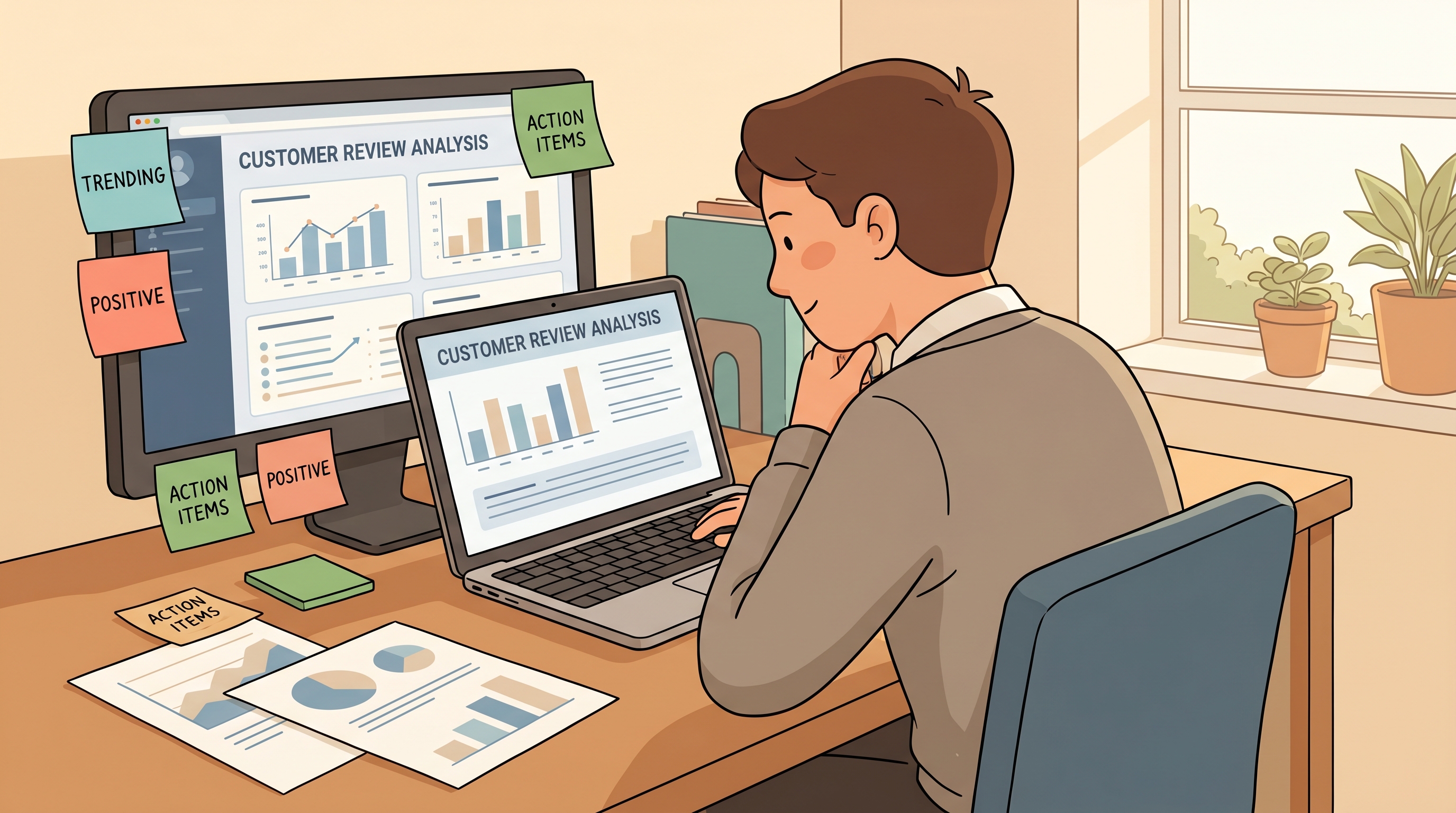
Your customers are already talking about you. Right now, across Google and Yelp, real people are writing detailed accounts of what it's like to do business with you — the highs, the lows, and everything in between. The question isn't whether those reviews matter (they do — a 2024 BrightLocal survey found that 98% of consumers read online reviews for local businesses). The real question is: what are you actually doing with all that feedback?
The reputation management software market has exploded in recent years, projected to reach $1.09 billion by 2026 according to Research and Markets. With dozens of tools vying for your attention — and your budget — choosing the right one has become its own challenge. Some platforms promise always-on monitoring across every social channel imaginable. Others take a fundamentally different approach, offering deep analytical snapshots that turn your review data into a strategic roadmap.
So how do you cut through the noise and find what actually fits your business? This buyer's guide breaks it all down.
Understanding the Two Core Approaches
Before you evaluate any specific tool, you need to understand that reputation tools generally fall into two distinct categories. Each serves a different purpose, and understanding the difference will save you from buying something you don't need — or missing something you do.
Always-On Monitoring Platforms
These are subscription-based tools that continuously scan review sites, social media, and other platforms for mentions of your business. They typically offer:
- Real-time alerts when new reviews are posted
- Review response management — reply to reviews from a single dashboard
- Social media tracking across Facebook, Instagram, Twitter/X, and more
- Review solicitation tools — automated emails or SMS asking customers to leave reviews
- Ongoing dashboards with live metrics
Popular examples include Birdeye, Podium, and Reputation.com. These platforms are best suited for businesses that need to manage high volumes of incoming reviews on a daily basis and want to actively solicit new reviews.
Typical cost: $200–$500+/month, often with annual contracts.
One-Time Deep-Dive Analysis Tools
These platforms take a different approach entirely. Instead of monitoring everything in real time, they collect your existing reviews, run them through sophisticated AI analysis, and produce a comprehensive report — a strategic snapshot of what your customers are actually saying.
This category focuses on:
- Sentiment and thematic analysis of existing reviews
- Industry benchmarking to show where you stand competitively
- Actionable recommendations backed by real customer quotes
- Trend identification over time (e.g., monthly rating trajectories)
- One-time reports rather than ongoing subscriptions
Zabble Insights falls into this category, analyzing Google Reviews and Yelp Reviews using AI to deliver professional reports with strategic recommendations.
Typical cost: One-time fees, often under $150 per report.
What Business Owners Actually Need (vs. What They're Sold)
Here's a truth that few vendors will tell you: most small and mid-sized business owners don't need an enterprise-grade monitoring platform. A 2023 GatherUp study found that the median local business receives roughly 5–15 new Google reviews per month. If that's you, paying $300/month for real-time alerts on a handful of reviews is like hiring a full security team to watch a single door.
That said, some businesses genuinely do need always-on monitoring. Here's a framework for figuring out which camp you're in.
You Likely Need Always-On Monitoring If:
- You receive 50+ reviews per month across multiple platforms
- You manage multiple locations and need centralized review response workflows
- Your industry is highly regulated (healthcare, finance) and negative reviews require immediate response protocols
- Review solicitation is a core strategy — you want to actively generate new reviews through automated campaigns
- You have a dedicated reputation manager or team who will actually use a dashboard daily
You Likely Need a Deep-Dive Analysis If:
- You want to understand patterns — not just individual reviews, but what your reviews collectively reveal about your business
- You're making a strategic decision — opening a new location, revamping your service model, or investing in staff training
- You need benchmarking data — how does your 4.2-star rating actually compare to others in your industry and market?
- You're budget-conscious and want maximum insight without a recurring subscription
- You've never systematically analyzed your reviews and want a clear starting point
The Honest Answer: Many Businesses Need Both (at Different Times)
These approaches aren't mutually exclusive. A restaurant owner might benefit from a deep-dive analysis report once or twice a year to identify systemic issues and track improvement, while using a lighter monitoring tool (even just Google Business Profile notifications) to stay on top of day-to-day reviews. The key is matching the tool to the task.
The Buyer's Checklist: 8 Things to Evaluate
Regardless of which approach you lean toward, here are the criteria that matter most when evaluating any reputation tool in 2026.
1. Data Sources — What Reviews Does It Actually Analyze?
This is the single most important question, and it's where many tools overpromise. Ask specifically:
- Does it pull from Google Reviews? (This is non-negotiable — Google dominates local search with roughly 73% of all online reviews, according to ReviewTrackers.)
- Does it include Yelp? (Still critical for restaurants, home services, and healthcare.)
- Does it cover platforms relevant to your industry? (TripAdvisor for hospitality, Healthgrades for medical, etc.)
- How many reviews does it actually collect and analyze? Some tools only sample a fraction.
Red flag: If a tool claims to analyze "all major platforms" but can't tell you exactly which ones and how many reviews it pulls, proceed with caution.
2. Depth of Analysis
There's a massive difference between a tool that counts your star ratings and one that performs genuine AI-powered sentiment analysis. Look for:
- Thematic categorization — Does it identify recurring topics (service speed, product quality, staff friendliness)?
- Sentiment beyond stars — A 4-star review can contain serious complaints. Does the tool catch that?
- Trend analysis — Can it show you how specific themes are changing over time?
- Direct evidence — Does it surface actual customer quotes to support its findings?
3. Benchmarking Capabilities
Your 4.3-star rating means nothing in a vacuum. A good tool should tell you how that compares to:
- Your industry average
- Top performers in your category
- Regional or market-specific norms
Robust benchmarking requires a large dataset. Ask how many businesses and reviews are in the benchmark database, and how often it's updated.
4. Actionability of Recommendations
Data without direction is just noise. The best tools don't just show you problems — they prioritize them by frequency and severity and suggest specific actions. Look for:
- Quick wins vs. long-term initiatives clearly separated
- Frequency metrics — "37% of negative reviews mention wait times" is actionable; "some customers are unhappy" is not
- Customer priority matrices that rank issues by impact
5. Report Quality and Accessibility
How will you actually consume and share the insights? Consider:
- Can you download a professional report to share with partners, investors, or your team?
- Is the format accessible (Word, PDF) or locked inside a proprietary dashboard?
- Does it include data visualizations that non-technical stakeholders can understand?
6. Pricing Transparency
The reputation management industry is notorious for opaque pricing. Before committing:
- Is pricing clearly listed on the website, or do you have to "book a demo" just to learn the cost?
- Are there annual contract requirements?
- What happens if you want to cancel?
- Are there per-location fees that multiply quickly for multi-unit businesses?
7. Time to Value
How quickly will you get usable insights?
- Always-on platforms often require onboarding, integration setup, and a learning curve
- Analysis tools can deliver insights within hours or days of ordering
- Consider your urgency — are you making a decision this quarter, or building a long-term monitoring habit?
8. What You Don't Need
This might be the most important evaluation criterion of all. Be honest about features you'll never use:
- If you don't have staff to manage a dashboard daily, a live dashboard adds no value
- If you're not going to run review solicitation campaigns, don't pay for that capability
- If you only care about Google and Yelp reviews, you don't need a tool that monitors 15 platforms
Every unused feature is wasted budget.
Common Mistakes Business Owners Make
After studying how thousands of businesses approach reputation management, a few patterns emerge:
- Over-buying: Signing up for a $400/month enterprise tool when a one-time analysis would answer their actual questions
- Under-analyzing: Glancing at their Google star rating occasionally but never systematically examining what customers are actually saying in the text of reviews
- Ignoring benchmarks: Celebrating a 4.1 rating without realizing their industry median is 4.4
- Confusing monitoring with understanding: Knowing you got a 2-star review today is monitoring; understanding that 42% of your negative reviews over the past year mention the same issue is analysis
The Bottom Line: Match the Tool to the Task
The reputation tool market in 2026 offers more options than ever, but more options doesn't mean more complexity — it means more opportunity to find exactly what fits.
If you need daily review management at scale, invest in a monitoring platform. If you need to understand what your reviews are truly telling you — the patterns, the benchmarks, the strategic priorities — invest in a deep-dive analysis.
And if you're in that second camp, Zabble Insights was built specifically for this purpose. It analyzes your Google Reviews (and optionally Yelp Reviews) using GPT-4.1-powered AI, benchmarks your performance against over 6,600 businesses across 22 industry categories, and delivers a professional Word document report packed with sentiment analysis, thematic findings, customer journey insights, and prioritized strategic recommendations — all backed by direct customer quotes. Reports start at $99 with no subscription required. You can explore sample reports and industry benchmarks on the Zabble Insights website to see exactly what you'd receive.
The best reputation tool is the one that answers your actual questions. Make sure you know what those questions are before you buy.
Frequently Asked Questions
What's the difference between review monitoring and review analysis?
Review monitoring is an ongoing, real-time process that alerts you when new reviews are posted so you can respond quickly. Review analysis is a deeper, typically one-time examination of your existing reviews to identify patterns, trends, sentiment themes, and strategic opportunities. Monitoring tells you what just happened; analysis tells you what it all means. Many businesses benefit from both at different times — monitoring for daily operations and analysis for strategic planning.
Do I need a tool that covers social media to manage my online reputation?
Not necessarily. While social media mentions can impact brand perception, the most influential factor for local business reputation remains review platforms — particularly Google, which hosts the majority of local business reviews. If your primary goal is understanding customer sentiment and improving your ratings, a tool focused specifically on review analysis (like one covering Google and Yelp) may deliver more targeted, actionable insights than a broad social listening platform that spreads analysis thin across many channels.
How much should a small business spend on reputation management tools?
It depends entirely on your review volume and goals. A small business receiving 5–15 reviews per month rarely needs a $300–$500/month monitoring subscription. For many small businesses, a one-time analysis report ($99–$150) combined with the free notification features built into Google Business Profile provides excellent coverage. Reserve ongoing subscription tools for when your review volume, multi-location complexity, or review solicitation strategy genuinely demands daily management.
How often should I analyze my business reviews?
For most small to mid-sized businesses, a comprehensive review analysis once or twice a year provides a strong strategic foundation. Key moments to invest in analysis include: before major business decisions (expansion, renovation, menu changes), after implementing improvements (to measure impact), when ratings shift noticeably up or down, or when entering a new market. Businesses with higher review volumes or rapidly changing customer bases may benefit from quarterly analysis.