Every business owner believes they know what their customers think. After all, you built the product, you hired the team, you designed the experience. But here's the uncomfortable truth: there is almost always a gap — sometimes a chasm — between the experience you think you're delivering and the one your customers actually describe in their Google and Yelp reviews. These blind spots don't just cost you star ratings. They cost you revenue, loyalty, and competitive advantage.
The good news? The evidence is already sitting there, in plain text, waiting to be analyzed. Customer reviews are the most honest, unsolicited feedback channel most businesses have access to. The problem is that very few businesses read them systematically, and even fewer extract the thematic patterns that reveal where their customer experience strategy is quietly failing.
The Perception Gap: Why Businesses Get It Wrong
Research from Bain & Company found that 80% of companies believe they deliver a superior customer experience, but only 8% of their customers agree. That's not a rounding error — it's a fundamental disconnect. And while that study is often cited at the enterprise level, the perception gap is arguably even wider for small and mid-sized businesses that lack dedicated CX teams and formal feedback loops.
Why does this happen? Several factors contribute:
- Confirmation bias: Business owners naturally pay more attention to positive feedback and dismiss negative reviews as outliers or unreasonable customers.
- Operational focus: When you're running day-to-day operations, you optimize for efficiency, not necessarily for the customer's emotional experience.
- Lack of systematic analysis: Reading individual reviews is not the same as analyzing hundreds of them for recurring themes, sentiment shifts, and severity patterns.
- Recency bias: A few recent compliments can overshadow a persistent, low-level problem that shows up in 15% of all reviews over the past year.
The result is that most businesses operate with an incomplete — and often inaccurate — picture of their customer experience.
What Reviews Actually Reveal: Five Common CX Blind Spots
When you perform thematic analysis across hundreds of Google and Yelp reviews, specific patterns emerge that business owners almost never anticipate. Here are five of the most common customer experience gaps that review data consistently uncovers.
1. The "Friendly Staff, Broken Process" Gap
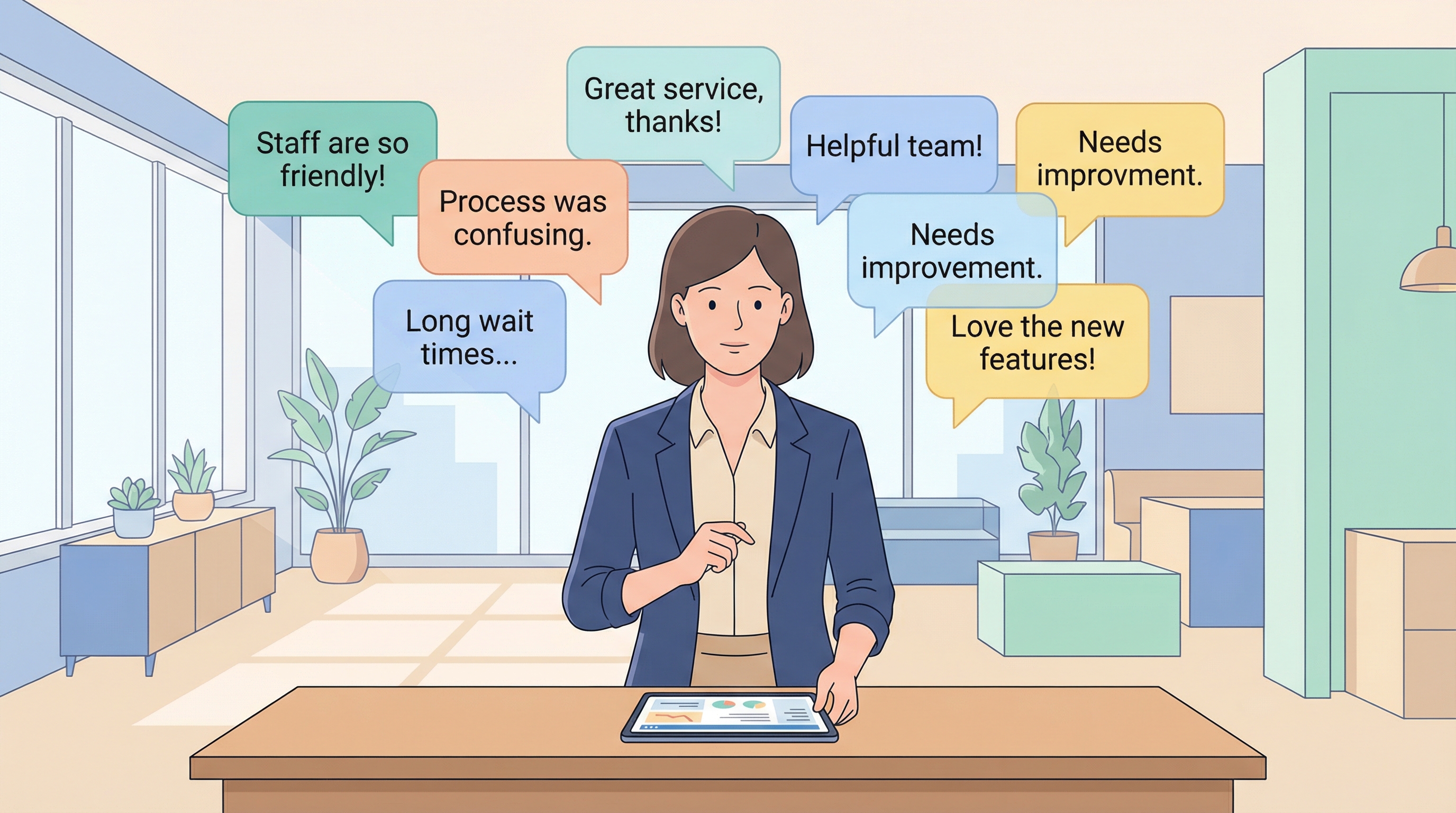
This is one of the most frequent disconnects. A business invests heavily in hiring warm, personable employees — and customers genuinely appreciate them. Reviews are full of praise for individual staff members. But buried alongside those compliments are consistent complaints about wait times, confusing checkout processes, scheduling errors, or poor communication between departments.
The business owner reads the staff compliments and feels validated. Meanwhile, the process failures are quietly eroding satisfaction. According to a PwC survey, 32% of customers say they would walk away from a brand they love after just one bad experience. Friendly staff cannot compensate for systemic friction indefinitely.
What this looks like in review data: - High sentiment scores for "staff" and "employees" categories - Low sentiment scores for "wait time," "scheduling," or "organization" categories - A gap between overall star ratings (which may still be decent) and the specific frustrations mentioned in review text
2. The "We Fixed That" Gap
Businesses evolve. You renovated the bathroom six months ago. You changed suppliers to improve product quality. You hired a new manager to fix the service issues. The problem is solved — in your mind.
But reviews tell a different story. Sometimes the fix didn't work as well as you thought. Sometimes the problem persists in a different form. And sometimes the negative reviews from before the fix are still sitting there, shaping the perception of new customers who read them today. A BrightLocal study found that 77% of consumers always or regularly read reviews when browsing for local businesses, and many don't filter by date.
What this looks like in review data: - A temporal trend showing improvement in one area but a new cluster of complaints emerging in a related area - Persistent negative themes that predate a known operational change, suggesting the fix was incomplete - Monthly rating trends that show a brief improvement followed by regression
3. The "Silent Majority" Gap
Most businesses focus on their most vocal critics and their most enthusiastic fans. But the most strategically important segment is often the customers who leave 3-star reviews — or who leave 4-star reviews with a caveat. These are the customers who were almost satisfied. They liked enough of the experience to not leave a scathing review, but something held them back from full enthusiasm.
Research from Harvard Business School suggests that a one-star increase in Yelp rating leads to a 5-9% increase in revenue for independent restaurants. The path from 3.8 stars to 4.3 stars often runs directly through understanding what these "almost satisfied" customers are telling you.
What this looks like in review data: - A disproportionate number of 3- and 4-star reviews compared to industry benchmarks - Recurring qualifiers in otherwise positive reviews: "great food but...," "love the location, however..." - Specific themes that appear almost exclusively in the 3-4 star range, distinct from the issues mentioned in 1-2 star reviews
4. The "First Visit vs. Repeat Visit" Gap
Customer journey analysis of review data often reveals a stark difference between the experience of first-time customers and returning ones. New customers may rave about the ambiance and the novelty, while repeat customers start noticing inconsistency — the quality varies from visit to visit, the special treatment they received initially fades, or the loyalty perks feel inadequate.
This gap is particularly dangerous because it means a business is good at acquisition but poor at retention. And since acquiring a new customer costs five to seven times more than retaining an existing one (according to Bain & Company), this blind spot has direct financial consequences.
What this looks like in review data: - Reviews mentioning "first time" or "just discovered" tend to have higher sentiment than reviews mentioning "regular," "always come here," or "used to be" - Themes of inconsistency and declining quality that correlate with reviewers who indicate repeat patronage - A customer journey analysis showing strong pre-purchase and first-experience sentiment but declining post-purchase and loyalty sentiment
5. The "We're Better Than Our Competitors" Gap
Business owners often have a strong sense of their competitive advantages. They know what makes them different. But when customers mention competitors in reviews, the comparison doesn't always go the way the business expects.
Thematic analysis of competitor mentions in reviews can reveal surprising insights: customers may prefer a competitor's pricing model, find another business more convenient, or view a supposed differentiator as irrelevant. The competitive positioning that exists in the business owner's mind may not match the competitive positioning that exists in the customer's experience.
What this looks like in review data: - Direct competitor mentions in reviews, often in the context of comparison or switching - Themes around value perception that don't align with the business's pricing strategy - Unique selling points that the business promotes but that rarely appear in positive review language
Why Traditional Review Reading Fails
Most business owners who do pay attention to reviews fall into one of two traps:
- Anecdotal reading: They scan reviews occasionally, react emotionally to particularly good or bad ones, and form impressions based on a small, unrepresentative sample.
- Star-rating fixation: They track their average rating obsessively but never dig into the text to understand what's driving it up or down.
Neither approach reveals the structural patterns described above. To uncover genuine CX gaps, you need:
- Volume: Analysis across dozens or hundreds of reviews, not a handful
- Thematic categorization: Grouping feedback into categories like service quality, product quality, value, and experience
- Sentiment scoring: Understanding not just what topics customers mention, but how they feel about each one
- Temporal analysis: Tracking how themes and sentiment shift over time
- Severity and frequency metrics: Knowing which issues affect the most customers and which cause the most damage
- Benchmarking: Comparing your performance against industry standards to understand whether a score is genuinely strong or just average
This is the difference between reading reviews and analyzing them.
Turning Blind Spots Into Strategic Advantages
Once you've identified your CX gaps, the strategic response follows a clear hierarchy:
Quick Wins (Address Within 30 Days)
These are issues that appear frequently in reviews, have high severity, and can be resolved with operational changes rather than major investment. Examples include: - Updating signage or communication to set accurate expectations - Adjusting staffing during peak hours identified in review complaints - Fixing a specific process breakdown that multiple reviewers mention
Medium-Term Improvements (1-3 Months)
These require more planning but address significant gaps: - Retraining staff on specific service touchpoints that reviews highlight - Revising pricing or value communication to align with customer perception - Implementing consistency standards to close the first-visit-vs-repeat-visit gap
Long-Term Strategic Initiatives (3-12 Months)
These address fundamental positioning and experience design: - Redesigning the customer journey based on stage-by-stage sentiment data - Repositioning competitive advantages based on what customers actually value - Building retention programs that address the specific loyalty-stage complaints found in reviews
The key is that every action should be traceable back to specific evidence in customer review data — not assumptions, not gut feelings, but actual words from actual customers.
How to Start Closing the Gap
If you suspect your business has CX blind spots — and statistically, it almost certainly does — the first step is getting an objective, data-driven analysis of what your customers are actually saying.
This is exactly what Zabble Insights is built to do. Zabble Insights uses AI-powered analysis of your Google Reviews (and optionally Yelp Reviews) to deliver a comprehensive professional report covering sentiment analysis, thematic categorization, customer journey mapping, competitive positioning, and strategic recommendations — all backed by direct customer quotes and benchmarked against industry data from over 22 business categories and approximately 4 million reviews. Each report is a detailed snapshot that turns hundreds of unstructured reviews into a clear, prioritized action plan.
You don't need to guess where your CX gaps are. Your customers have already told you. You just need the right analysis to hear them.
Frequently Asked Questions
What are customer experience gaps in the context of online reviews?
Customer experience gaps are the differences between the experience a business believes it delivers and the experience customers actually describe in their reviews. These gaps become visible when you perform systematic thematic and sentiment analysis across a large volume of Google and Yelp reviews, revealing recurring complaints, unmet expectations, and blind spots that individual review reading typically misses. Common examples include process failures that coexist with staff praise, inconsistency between first and repeat visits, and competitive positioning that doesn't match customer perception.
How many reviews do you need to identify meaningful CX patterns?
While even a small number of reviews can surface individual issues, meaningful thematic analysis typically requires at least 80-100 reviews to identify statistically significant patterns. With 80-300 reviews, AI-powered analysis can reliably detect recurring themes, measure their frequency and severity, track sentiment trends over time, and distinguish genuine systemic issues from isolated incidents. Businesses with fewer reviews can still benefit from analysis but should interpret patterns with appropriate caution.
Can Google and Yelp reviews really reveal problems a business doesn't know about?
Absolutely. Research consistently shows a major perception gap between businesses and their customers — Bain & Company's often-cited finding that 80% of companies believe they deliver superior CX while only 8% of customers agree illustrates this vividly. Reviews capture the unfiltered voice of the customer, including frustrations they may never mention in person. Thematic analysis of review text frequently uncovers issues that business owners either weren't aware of, believed they had already fixed, or underestimated in terms of frequency and impact.
What's the difference between reading reviews and analyzing them?
Reading reviews is an informal, anecdotal process — you scan a few reviews, react to the most emotional ones, and form impressions. Analyzing reviews means systematically processing dozens or hundreds of reviews to extract structured insights: categorizing feedback into themes, scoring sentiment by category, measuring issue frequency and severity, tracking trends over time, mapping the customer journey, and benchmarking results against industry standards. Analysis reveals patterns that are invisible to casual reading, especially in businesses with 100+ reviews across platforms.