Every business owner knows that great customer service matters. But how much does it actually matter — in dollars, in stars, in measurable return on investment? For decades, the link between service improvements and bottom-line results has been frustratingly fuzzy. You'd invest in training, hire better staff, overhaul your processes, and then... hope the numbers moved. That era is ending. AI-driven review analysis is finally giving businesses the ability to draw a clear, data-backed line between customer service investments and the rating gains, reputation lifts, and revenue increases that follow.
The shift isn't theoretical. It's happening right now in the reviews your customers leave on Google and Yelp — the two platforms that overwhelmingly shape how consumers discover and evaluate local businesses. Let's explore how AI is transforming the way we measure, understand, and maximize the ROI of customer service.
The Customer Service ROI Problem
Customer service has always been considered a cost center. You spend money on it, and the returns are indirect — fewer complaints, more repeat visits, better word of mouth. But quantifying those returns? That's where things get murky.
Consider the traditional approach:
- Invest in a new training program or hire additional staff
- Wait several months for results to materialize
- Check high-level metrics like overall rating or complaint volume
- Guess whether the investment caused any improvement
The problem is step four. Without granular data, businesses can't isolate which service changes drove which outcomes. Did your rating go up because of the new greeting protocol, or because a negative reviewer deleted their post? Was the drop in complaints due to better resolution processes, or just a slow month?
According to a 2023 report by Qualtrics, 80% of customers say they have switched brands because of a poor customer experience, and yet only 22% of business leaders feel they have a strong understanding of what drives customer satisfaction. That gap — between knowing service matters and knowing what specifically matters — is exactly where AI-driven review analysis is making its mark.
How AI Transforms Review Data Into ROI Insights
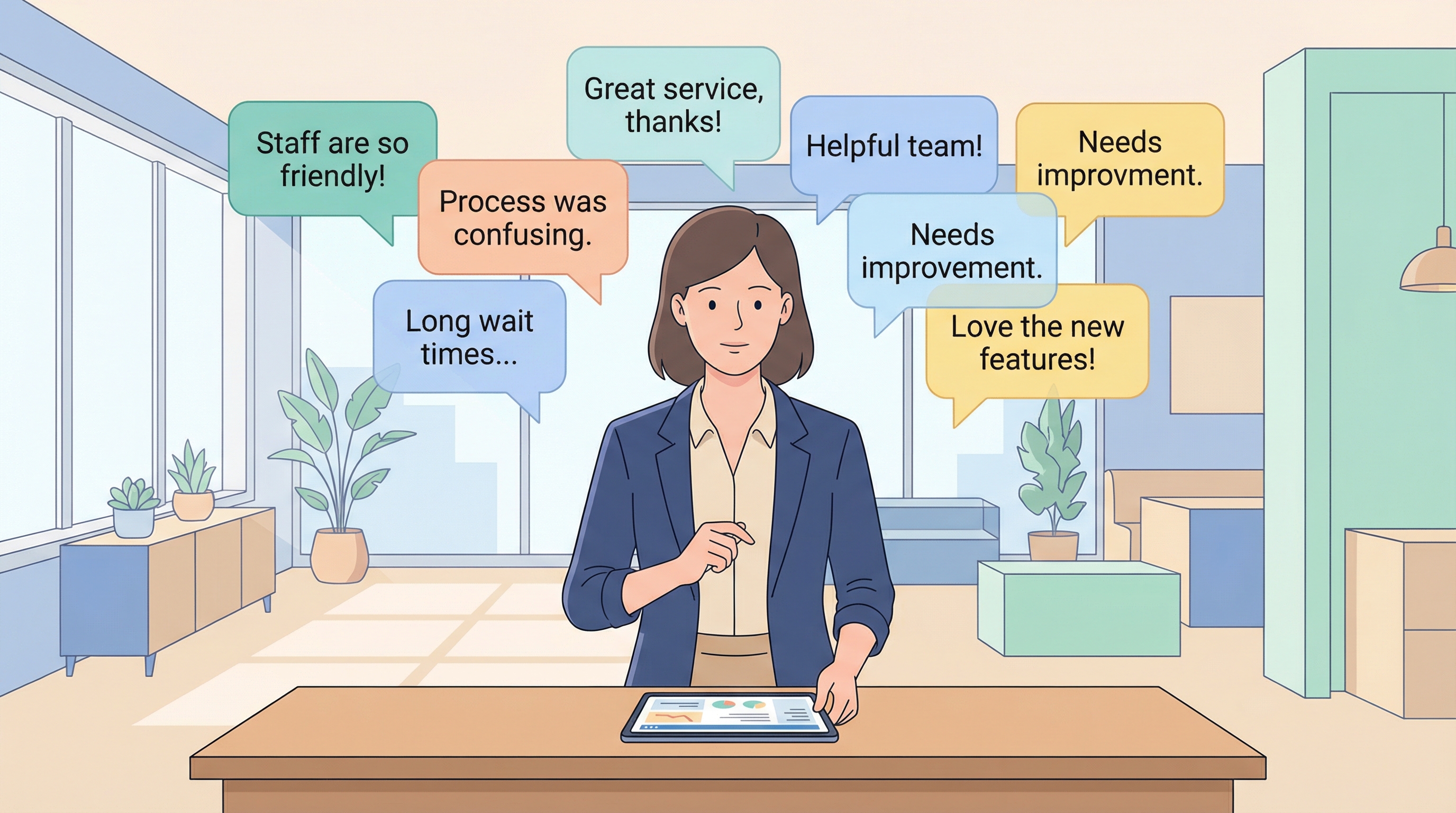
Google and Yelp reviews are goldmines of unstructured customer feedback. A single business might have hundreds of reviews spanning years, each containing specific observations about service speed, staff friendliness, problem resolution, product quality, and more. The challenge has always been extracting structured, actionable intelligence from all that text.
This is where AI — specifically large language models and natural language processing — changes the game.
From Text to Themes
Modern AI can read hundreds of reviews and identify recurring themes with remarkable precision. Rather than manually scanning reviews and making subjective judgments, AI-powered analysis can:
- Categorize sentiment across dimensions like service quality, product quality, value, and overall experience
- Quantify frequency — telling you not just that "wait times" are an issue, but that 34% of negative reviews mention them
- Track trends over time — showing whether a specific issue is getting better or worse month over month
- Surface direct customer quotes that illustrate each finding with real evidence
- Map the customer journey — identifying whether problems cluster at the pre-purchase, purchase, or post-purchase stage
This transforms reviews from anecdotal noise into structured business intelligence.
Connecting Service Changes to Rating Movements
Here's where ROI measurement gets powerful. When you combine thematic analysis with monthly rating trend data, you can start to see cause and effect.
For example, imagine a restaurant owner who invested in front-of-house training in March. AI analysis of their Google and Yelp reviews might reveal:
- Before March: 28% of reviews mentioned slow service; average monthly rating was 3.6
- After March: Mentions of slow service dropped to 11%; average monthly rating climbed to 4.2
- Supporting quotes: Reviewers specifically praised "attentive staff" and "quick seating" in the months following the change
That's not a guess. That's a measurable, evidence-backed connection between a service investment and a rating outcome.
The Financial Impact of Rating Improvements
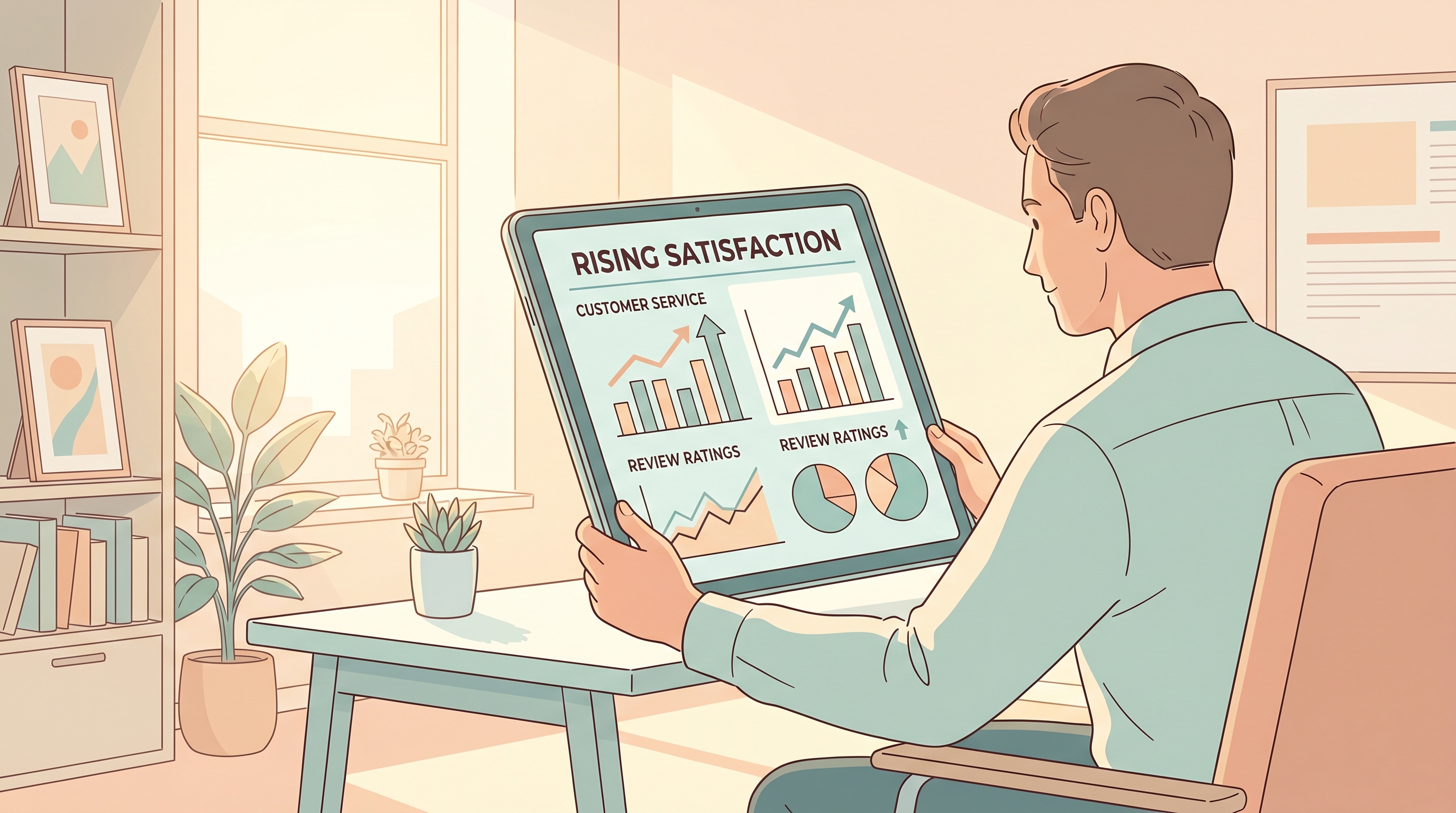
Rating gains aren't just vanity metrics. Research consistently shows they translate directly to revenue.
- A Harvard Business School study found that a one-star increase on Yelp leads to a 5-9% increase in revenue for restaurants
- According to BrightLocal's 2024 Local Consumer Review Survey, 98% of consumers read online reviews for local businesses, and 76% regularly read them
- Google's own data indicates that businesses with ratings above 4.0 receive significantly more clicks and direction requests than those below that threshold
- A Spiegel Research Center study showed that displaying reviews can increase conversion rates by up to 270%, with the effect being strongest for higher-priced products and services
When you combine these data points, the math becomes compelling. If AI analysis helps you identify and fix a service issue that's dragging your rating down by half a star, the revenue implications can be substantial — potentially thousands or tens of thousands of dollars annually for a local business.
Industry Benchmarks: Knowing Where You Stand
One of the most valuable aspects of AI-driven review analysis is the ability to benchmark your performance against your industry. A 4.2-star rating might be excellent for an auto repair shop but merely average for a bakery. Without context, raw ratings are misleading.
Comprehensive benchmark datasets — built from analyzing millions of reviews across thousands of businesses in dozens of categories — provide that context. They answer critical questions:
- Is my rating above or below the median for my industry?
- How does my sentiment breakdown compare to top performers?
- Are the issues my customers mention common across my category, or unique to my business?
This benchmarking transforms review analysis from a mirror into a map. You're not just seeing where you are — you're seeing where you need to go and how far you have to travel.
The Customer Priority Matrix: Where to Invest Next
Not all service issues are created equal. Some are mentioned frequently but aren't particularly severe. Others are rare but devastating when they occur. Smart ROI optimization requires knowing which problems to fix first.
AI analysis can generate what's known as a customer priority matrix — a framework that ranks issues by two dimensions:
- Frequency: How often does this issue appear in reviews?
- Severity: How negatively does it impact sentiment when it does appear?
Issues that are both frequent and severe are your highest-priority investments. Here's how this might look in practice:
| Issue | Frequency | Severity | Priority |
|---|---|---|---|
| Long wait times | High (mentioned in 31% of negative reviews) | High (average rating when mentioned: 1.8) | Critical |
| Limited parking | Medium (14% of reviews) | Low (average rating: 3.1) | Monitor |
| Rude staff interaction | Low (7% of reviews) | Very High (average rating: 1.2) | High |
| Menu variety | Medium (18% of reviews) | Medium (average rating: 2.6) | High |
With this data, a business owner can make informed decisions about where to allocate their customer service budget for maximum impact. Fixing wait times will likely yield the biggest rating improvement because it's both common and damaging. Addressing parking, while mentioned often enough, won't move the needle as much because customers don't rate it as severely.
Quick Wins vs. Long-Term Initiatives
AI-driven analysis also helps distinguish between quick wins and long-term strategic initiatives — a critical distinction for ROI planning.
Quick Wins
These are changes that can be implemented rapidly and address issues appearing frequently in reviews:
- Adjusting staffing during peak hours to reduce wait times
- Improving greeting and acknowledgment protocols
- Adding clearer signage or communication about policies
- Responding to reviews to show engagement (research from Harvard Business Review shows that responding to reviews can increase subsequent ratings)
Long-Term Initiatives
These require more investment but address deeper structural issues:
- Comprehensive staff training programs
- Facility renovations or upgrades
- Menu or service offering overhauls
- Technology investments (online ordering, appointment scheduling)
The key insight is that AI analysis doesn't just tell you what to fix — it helps you prioritize when to fix it based on the expected impact on your reviews and ratings.
Real-World Applications Across Industries
The power of AI-driven review analysis for customer service ROI extends across virtually every industry category:
- Restaurants and hospitality: Identifying whether food quality, service speed, ambiance, or value is the primary driver of satisfaction or dissatisfaction
- Healthcare practices: Understanding patient sentiment around wait times, bedside manner, billing clarity, and front-desk interactions
- Auto services: Pinpointing whether trust, pricing transparency, communication, or turnaround time matters most to customers
- Retail: Discovering whether product selection, staff knowledge, store layout, or return policies dominate the review conversation
- Home services: Evaluating punctuality, communication, workmanship quality, and pricing fairness as separate performance dimensions
In each case, the reviews are already there — sitting on Google and Yelp, waiting to be transformed from scattered opinions into a structured improvement roadmap.
The Shift From Reactive to Proactive
Perhaps the most profound way AI is reshaping customer service ROI is by enabling a shift from reactive to proactive management.
Traditionally, businesses react to problems after they've already damaged the brand — a viral negative review, a sudden rating drop, a pattern of complaints that someone finally notices. AI-powered review analysis flips this dynamic by providing a comprehensive snapshot of where things stand right now, complete with trend data showing the direction things are heading.
When you can see that mentions of "billing confusion" have increased from 5% to 19% of negative reviews over the past six months, you can address the issue before it becomes a crisis. When you can see that your rating is trending downward while your industry benchmark is holding steady, you know something specific needs attention.
This is the essence of modern customer service ROI: using data to invest proactively in the changes that will have the greatest measurable impact on your reputation and revenue.
Turning Your Reviews Into a Strategic Asset
If you're ready to stop guessing about the ROI of your customer service investments and start measuring it with real data, Zabble Insights can help. Our AI-powered platform analyzes your Google Reviews (and optionally Yelp Reviews) using GPT-4.1 to deliver a comprehensive professional report — complete with sentiment analysis, thematic breakdowns, monthly trend tracking, a customer priority matrix, strategic recommendations, and benchmarking against over 6,600 businesses across 22 industry categories.
Each report is a detailed, 15-20 page Word document packed with direct customer quotes, frequency metrics, and actionable insights you can use to prioritize your next service improvement. Reports start at $99 per business, with no subscription required — it's a one-time analysis snapshot designed to give you clarity and direction.
Explore sample reports and see what AI-driven review analysis can reveal about your business at zabbleinsights.com.
Frequently Asked Questions
How does AI review analysis help measure customer service ROI?
AI review analysis transforms unstructured customer feedback from Google and Yelp reviews into structured, quantifiable data. By categorizing sentiment across dimensions like service quality, product quality, and value — and tracking how those metrics change over time — businesses can draw direct connections between service investments and rating improvements. When combined with research showing that each star increase can drive 5-9% revenue gains, this data makes the ROI of customer service investments measurable and concrete.
What types of customer service issues can AI identify from reviews?
AI-powered review analysis can identify a wide range of service-related issues, including wait times, staff friendliness, communication quality, problem resolution, billing clarity, cleanliness, and more. Critically, it doesn't just identify these themes — it quantifies them by frequency (what percentage of reviews mention the issue) and severity (how much the issue impacts ratings), allowing businesses to prioritize improvements based on expected impact.
How many reviews does AI need to produce meaningful insights?
Meaningful analysis typically requires a minimum of 80 reviews, though the richest insights come from larger datasets. Platforms like Zabble Insights analyze up to 300 Google reviews and up to 300 Yelp reviews per business, covering the most recent three years of feedback. This volume provides enough data to identify statistically meaningful patterns, track monthly trends, and generate reliable thematic breakdowns.
Can AI review analysis compare my business to industry competitors?
While AI review analysis of your own reviews won't generate full competitor reports, it can surface competitor mentions that appear naturally in your reviews — for example, when customers compare your service to a rival. Additionally, industry benchmarking data (built from analyzing millions of reviews across thousands of businesses) allows you to see how your ratings, sentiment scores, and category performance compare to the median, average, and top performers in your specific industry category.